what do computer-generated numerical models try to predict
The history of numerical weather prediction (NWP) at the Met Office, from the early 1950s to nowadays.
NWP uses the latest weather condition observations aslope a mathematical estimator model of the atmosphere (such as the Unified Model run at the Met Function) to produce a weather forecast.
The Met Office is recognised as a world leader in NWP, dating back to the pioneering work of Lewis Fry Richardson afterward he joined the Met Office in 1913. The Met Function produced its beginning operational computer forecast on 2 November 1965.
NWP is now at the heart of all weather forecasts and warnings as well as much of the enquiry and evolution undertaken to understand our conditions and climate.
1952 to 1965 - The start of NWP in the UK
Early experiments
The first NWP forecast in the UK was completed past F. H. Bushby and Yard. 1000. Hinds in 1952 under the guidance of J. S. Sawyer FRS. These experimental forecasts were generated using a 12 × 8 grid with a grid spacing of 260 km, a one hour time-footstep, and required four hours of computing time for a 24 60 minutes forecast on the EDSAC computer at Cambridge and the LEO calculator of Lyons Co.
Following these initial experiments, work moved to the Ferranti Mark 1 computer at the Manchester University Department of Electrical Applied science.
Shooting star
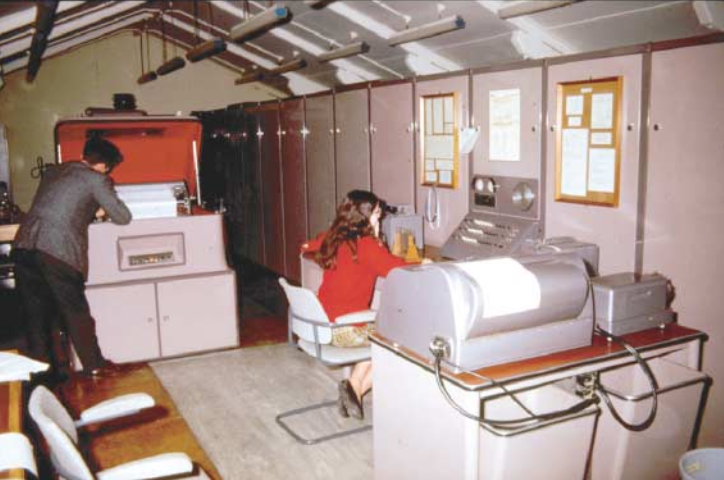
In January 1959, a Ferranti Mercury computer, known as 'Shooting star', was installed at the Met Office in Dunstable. This was a significant milestone due to it existence the showtime computer defended to NWP enquiry.
Meteor was used to trial an operational forecasting suite in early 1960, using the improved Bushby–Whitelam three level model covering western Europe and the North Atlantic.
It consisted of a six hr forecast from an 0000 UTC assay, followed past a 0600 UTC re-assay and a 24 hour forecast. The forecasts took too long to run and it was concluded that a more powerful and reliable computer was required.
Comet
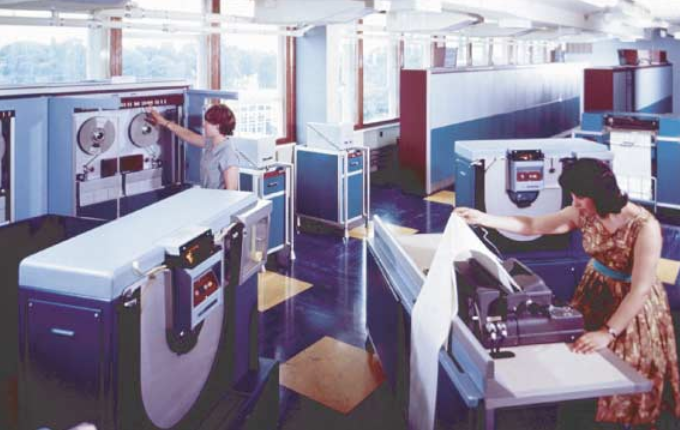
The computer which replaced Meteor was the English Electric KDF9, called 'Comet', which was installed at the Met Office in Bracknell in 1965 and cost £500,000.
Comet used transistors, had a speed of sixty,000 arithmetic operations per second, a memory of 12,000 numbers and could output charts in both zebra form on a line printer and later on a pen plotter.
1965 onwards - Operational NWP forecasts at the Met Office
The commencement operational computer forecast was produced by the Met Office on ii November 1965, using the Comet estimator. The media were invited to witness this landmark in the history of the Met Part and gave it unprecedented coverage both in the press and on TV.
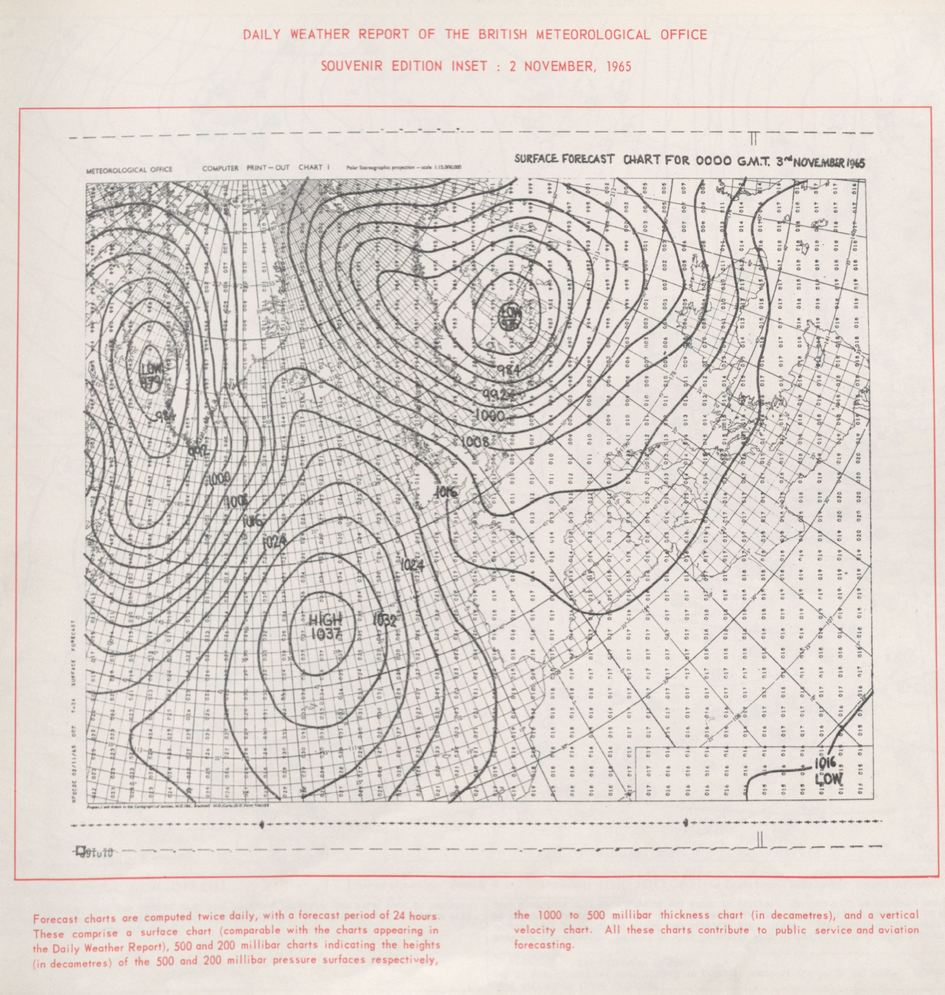
Above: The beginning operational NWP forecast produced past the Met Office on 2 November 1965. The forecast shows surface pressure level valid at 0000 GMT on 3 November 1965.
Comet provided the capability to produce forecasts twice a day using the three level dry filtered Bushby-Whitelam model roofing the North Atlantic and Western Europe on a 300 km horizontal grid length at 60°N. Initial statistics were produced using a local surface fitting method for the summit field and the residuum equation for winds.
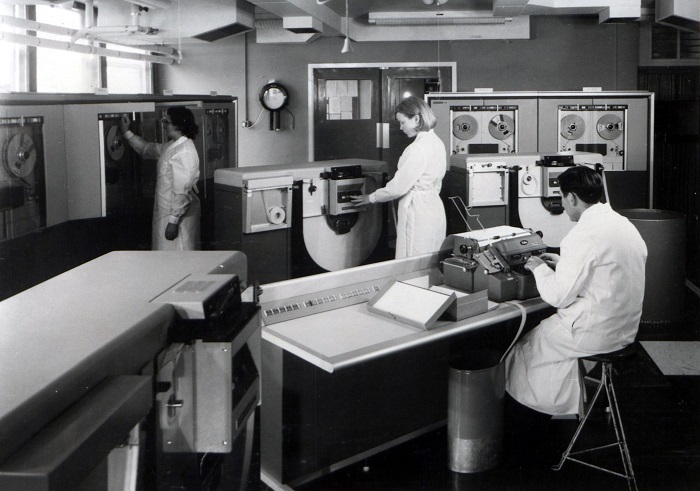
Higher up: The English Electric KDF9 'Comet' computer at the Met Part (Bracknell) in 1966.
1970s - Global commutation of weather condition observations
The global commutation of weather observational information grew apace every bit the Global Telecommunications System of the World Meteorological Organisation (WMO) transformed advice betwixt National Weather condition Services and satellite data began to be exchanged. Equally one of the hubs on the Principal Trunk Network (MTN), the Met Office installed a pair of Marconi Myriad computers dedicated to message routing.
1971 - IBM 360/195 estimator
The IBM 360/195 calculator was used between 1971 and 1982. Information technology had a speed of four million arithmetic operations per 2nd and a memory of 250,000 numbers, and was installed in the newly congenital Richardson Wing of the Met Part headquarters.
Unlike its predecessor, this computer was synthetic using integrated circuits. Forecasters could interact with the estimator through an interactive screen and keyboard. A microfilm plotter provided a new, flexible, output medium.
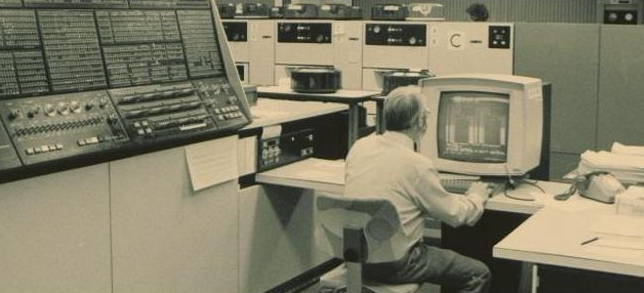
In a higher place: A view of the figurer hall housing the IBM 360/195 at the Met Office (Bracknell) in 1971.
1972 - x-level model
The x-level Bushby-Timpson model, was based on a scheme formulated by J. S. Sawyer, solved the Navier–Stokes equations of fluid motion, and the thermodynamic, heat transfer and continuity equations, in their primitive forms, obviating the demand for the geostrophic assumption.
It was implemented in 1972, start in the Octagon model, with a 300 km grid length at sixtyoN and was run twice daily for iii day Northern Hemisphere forecasts.
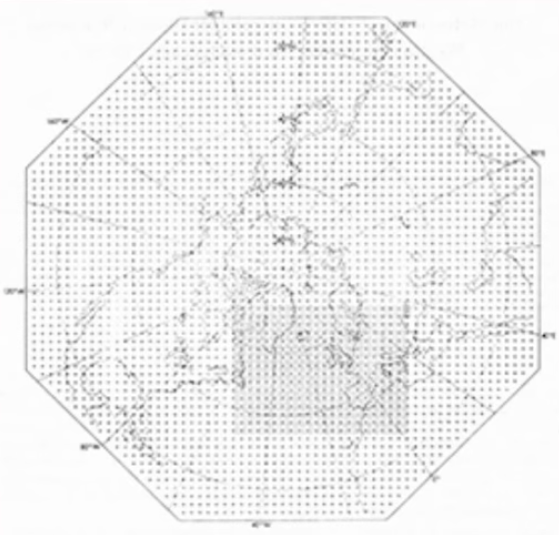
A year later the Rectangle model was implemented, with a 100 km grid covering much of the Due north Atlantic and Europe (shown by the darker gray shading in image on the right). This had the specific aim of predicting rainfall from fronts.
The models were initialised past fitting orthogonal polynomial surfaces through summit observations and then deriving winds using the balance and omega equations. Radiosondes were the primary observation source, supplemented by AIREPS and the first satellite observations: SIRS & SATEMS.
1976 - Sea wave forecasts
The Met Function interest in numerical wave forecasting dates from 1974, when provision of weather services to the developing N Ocean oil industry needed support in the prediction of long period great.
A first generation model was implemented in 1976, followed by a more sophisticated second generation model in 1979. This remained the foundation of Met Function ocean wave services until 2008, when the third generation U.s.a. WAVEWATCH III® model was implemented.
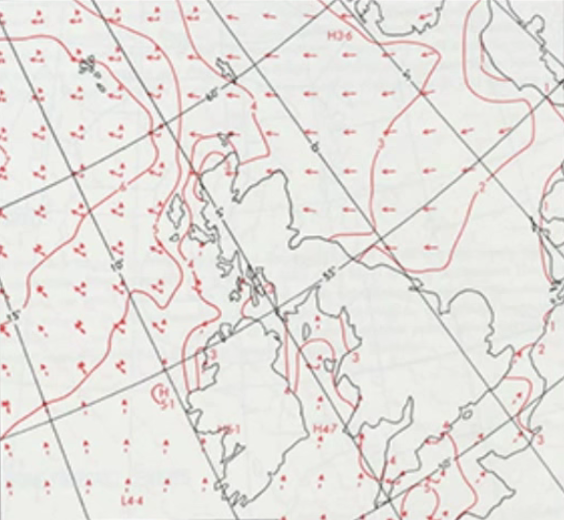
Above: I of the early bounding main wave forecasts.
1980s - Forecaster guidance
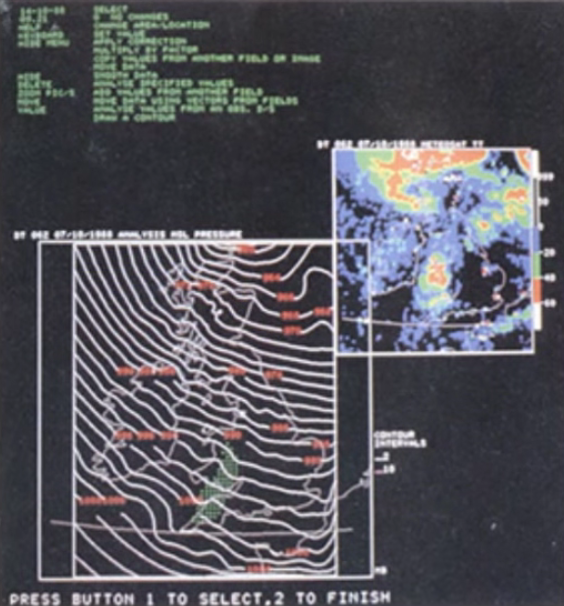
During the 1980s, NWP output reached forecasters in the Central Forecast Function, through interactive monitors and on charts produced by large flat-bed plotters, while communications advances enabled NWP outputs to be sent to forecasting outstations through certificate facsimile (GRAFNET) and the Outstation Display System (ODS).
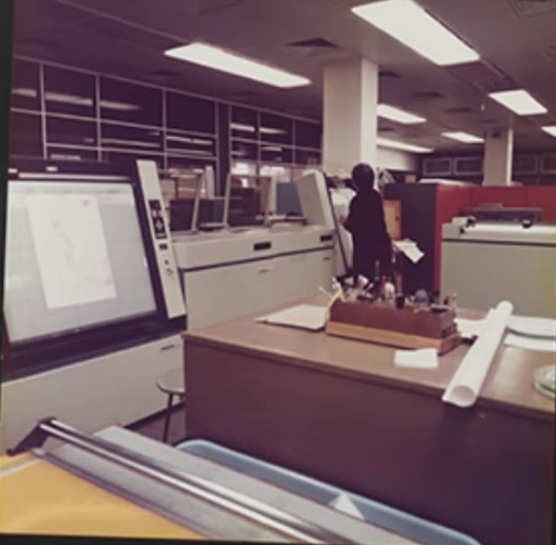
Above: One of the interactive monitors in the Primal Forecast Office during the 1980s.
Above: How the first forecaster guidance used to look in the 1980s, every bit displayed on interactive monitors.
1982 - Global capability
A new fifteen-level NWP model was implemented in 1982 using a development of the ten-level model dynamical cadre for a latitude-longitude grid with concrete parametrizations derived from the Full general Circulation Model developed for enquiry during the First GARP Global Experiment (FGGE) in the late 1970s.
Information technology was speedily extended to a global adequacy to provide military support following the invasion of the Falkland Islands in 1982.
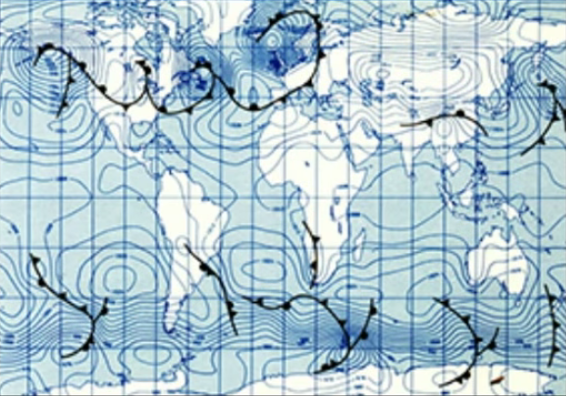
It used an optimum interpolation information assimilation scheme, combined with nudging, also used in FGGE. An example of an early global NWP forecast is shown in the epitome on the right.
1985 - Mesoscale NWP
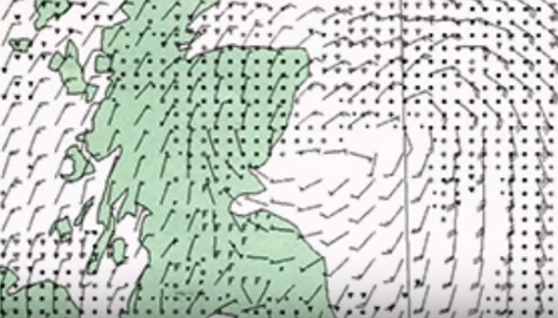
In guild to remove limitations on the representation of vertical circulations associated with convection and complex topography, a new higher-resolution model was adult from the early 1970s using a non hydrostatic, compressible equation set with a semi-implicit handling of audio waves (Tapp and White 1976).
It was implemented for routine atmospheric condition forecasting use in 1985 and was the first such model to be used operationally in the world. It covered only the UK and was aimed at forecasting topographically forced local weather such as sea breeze convection and fog.
The parametrizations of deject and turbulence were much more than sophisticated than those used in the global and regional models of the time. The model was initialised by downscaling from the regional model and and then adding local item from radar, satellite and surface observations using the Interactive Mesoscale Initialisation (IMI). An example of its output is shown in the paradigm above.
1986 - Chernobyl and Proper noun
Following the widespread dispersion of the radioactive deject from the Chernobyl accident in 1986, the Proper name dispersion modelling system was initially developed.
Name has subsequently been continuously developed and used to model dispersion from an even wider range of hazards including chemical fires, volcanic eruptions and disease outbreaks.
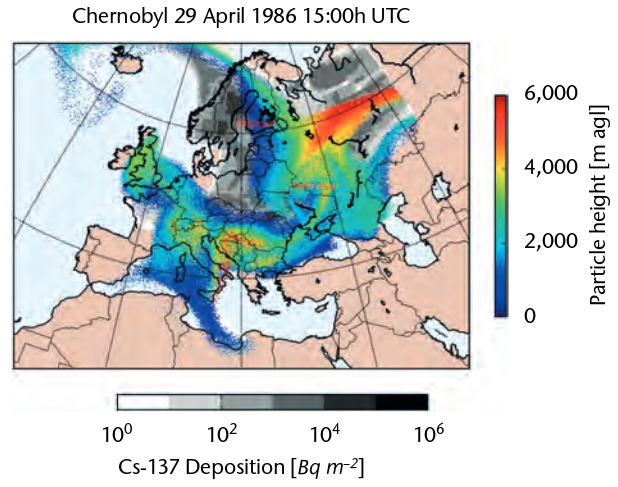
Higher up: A dispersion forecast of the radioactive plume following the Chernobyl blow in 1986, using a modern version of Name.
1990 - The Unified Model
The Unified Model is a numerical model of the temper which is used for both atmospheric condition and climate applications. Real time testing was carried out in 1990, with the operational implementation on 12 June 1991.
The Unified Model was ready up with a global and limited surface area model for brusk range forecasts and the ability to run long range climate simulations. At the time of implementation, the global model for short range forecasts had a horizontal resolution of 0.833 degrees latitude × one.25 degrees longitude (~90 km), the global model for climate simulations had a horizontal resolution of 2.five degrees latitude × 3.75 degrees longitude (~300 km). The initial implementation too had a set of standard model levels in the vertical, with twenty levels used for brusque range forecasts and 42 levels used for global climate simulations.
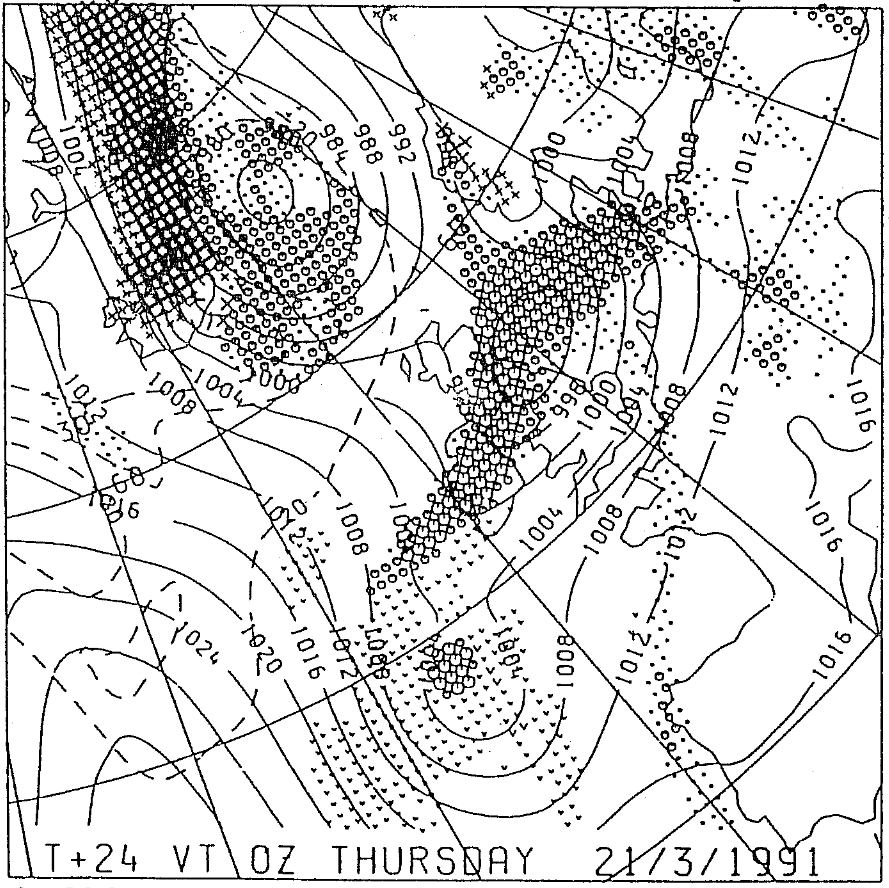
In a higher place: An early instance of a 24 hour forecast showing mean sea level pressure and precipitation from the express surface area version of the Unified Model, valid at 00 UTC on 21 March 1991. From Cullen (1993).
The Unified Model is in continuous development by the Met Part and its partners, adding state of the art understanding of atmospheric processes to new releases. For example, the operational global resolution run at the Met Office improved from 90 km in 1991 to 10 km in 2017. In a 2nd example, the data assimilation scheme was upgraded to 3D-Var in 1999, to 4D-Var in 2004 and now uses an ensemble to provide information on the model starting time approximate error construction. In a final example, in 2003 the Unified Model was upgraded with a compressible, non-hydrostatic, dynamical core. More recently, information technology has seen further upgrades with the more accurate ENDGame core.
1995 - Nowcasting
The FRONTIERS man-auto nowcasting arrangement for rainfall, based on radar and satellite information, was outset implemented in the late 1980s.
Its fully automated successor was Nimrod, implemented in 1995, which provided detailed forecasts of a variety of weather condition elements for the showtime few hours alee.
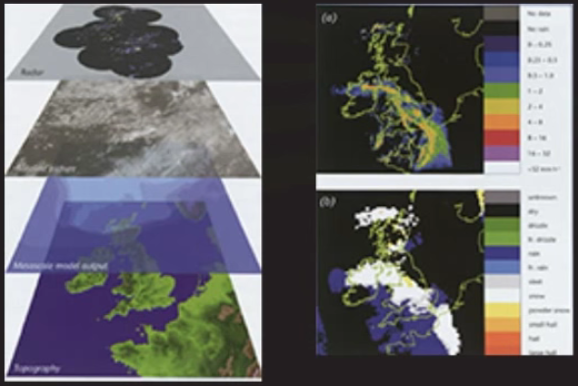
Above: Example forecast output from the Nimrod nowcasting system in the mid 1990s.
2000 - Site specific forecasts
Initial attempts to produce automatic worded site-specific forecasts were made in the 1970s using gridpoint output from the Rectangle model. Business relationship of local topography and country use was addressed using the site-specific forecast model (SSFM) in the belatedly 1990s.
The advent of mobile communications made delivery of high density local forecasts realistic and the Met Office launched the Fourth dimension and Place service, delivered using the WAP mobile phone protocol, in 2000.
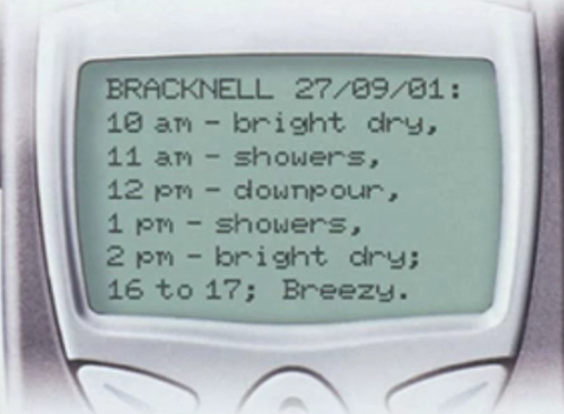
Above: An example site specific forecast from 2001 presented on a mobile phone.
With electric current loftier resolution NWP, forecasts for thousands of U.k. and global locations are at present generated by diagnostic downscaling, and are bachelor to view on our website and weather condition app.
2003 - Moving the supercomputer
When the Met Office moved from Bracknell to Exeter in 2003 it involved one of the largest Information technology relocations ever attempted, including the physical transport of the existing supercomputers (Cray T3E supercomputers; shown below).

Two computers were moved separately with one maintaining forecasts in Bracknell until the other took over in Exeter. The motion was completed two weeks early without a single forecast missed.
2005 - Ensemble forecasting
Following early on work on seasonal ensemble forecasting in the tardily 1980s, the Met Function full-bodied on interpreting ECMWF medium range ensemble forecasts.
However, when the value of ensemble forecasts at shorter ranges became evident, the Met Office Global and Regional Ensemble Prediction Organisation (MOGREPS) was implemented in 2005, becoming fully operational in 2007 (Bowler et al., 2008).
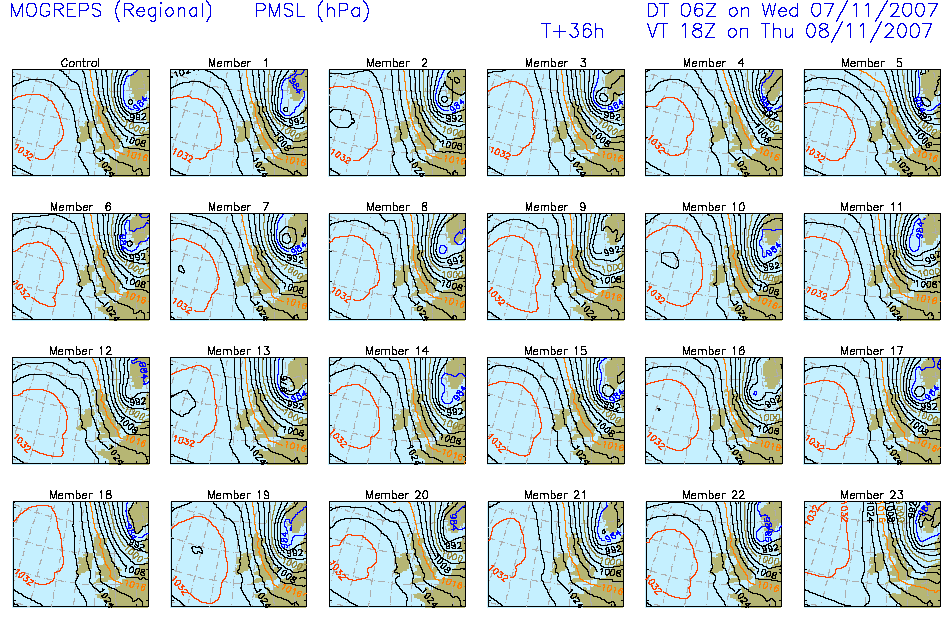
To a higher place: A 36 hour forecast from each ensemble member within the regional component of MOGREPS, ahead of the East Declension storm surge on 9 Nov 2007.
2010 - UK convective calibration model
Following earlier work with a 4 km grid-length model, the first truly convection-permitting UK model was introduced in 2010, with 1 of the early on operational forecasts shown below.
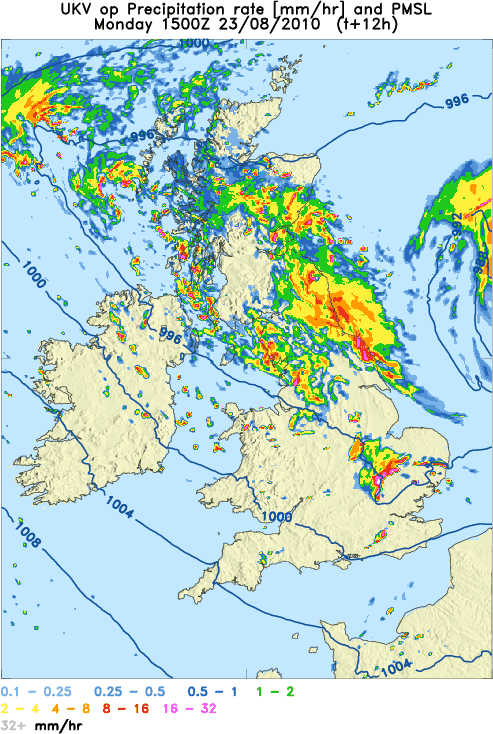
Above: I of the first operational convection-permitting forecasts in 2010.
This model is all the same in employ today and has a variable horizontal resolution, leading information technology to be known as the 'UKV' model. The variable grid-length gives a ane.v km grid resolution over the British Isles, providing unprecedented detail of local atmospheric condition including convection (Tang et al., 2012).
The main benefit of the UKV is to better resolve convective showers or storms which, in extreme cases, can give rise to major flooding events or disruptive snow in winter.
Convective clouds are typically less than 10 km in horizontal extent and and then have to exist represented every bit subgrid processes at global model resolutions. In contrast, a 1.5 km model can oftentimes produce the convection explicitly on the model grid.
2012 - Convection permitting ensemble
Recognising that convective scale detail has limited predictability due to curt length scales and rapid chaotic error growth, the UKV model was complemented with a two.ii km UKV-based ensemble, MOGREPS-UK, which was first demonstrated for the London 2012 Olympic Games (Golding et al., 2014 and Tennant, 2015).
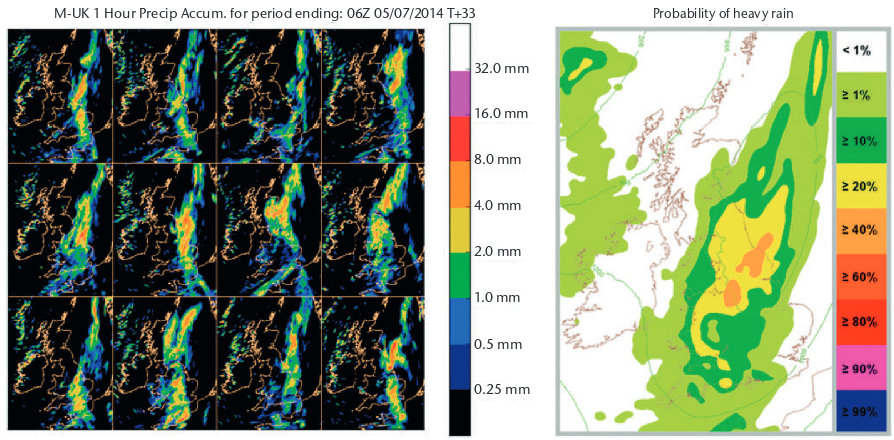
Above: Case of using MOGREPS-United kingdom to capture the uncertainties in exactly where heavy rainfall volition occur across the U.k. associated with a frontal system. Left image: rainfall forecasts from the 12 MOGREPS-UK ensemble members. Right image: probability of heavy rainfall, derived by neighbourhood processing the 12 ensemble members.
2015 to 2017 - Cray XC40 supercomputer
The first part of the Met Office'southward latest supercomputer arrived in 2015 and was fully installed by 2017.
At present complete, this new computer (shown below) has 460,000 cores which delivers a peak functioning of 16 petaflops. It has 2 petabytes of memory for running complex calculations and 24 petabytes of storage for saving data.

The increased ability enables even higher resolution forecasts. Experiments at resolutions effectively than i km are already showing amazingly authentic detail, while refinements to our longer range forecasts are reproducing the global scale circulation changes that influence the character of our seasonal weather.
References
Bowler Due north, Arribas A, Mylne K, Robertson K, Beare S. 2008. The MOGREPS short-range ensemble prediction organisation.Q. J. R. Meteorol. Soc. 134: 703–722
Cullen MJP. 1993. The unified forecast/climate model. Meteorol. Magazine. 112: 81–9
Golding BW, Ballard SP, Mylne Grand, Roberts Northward, Saulter A, Wilson C, Agnew P, Davis LS, Trice J, Jones C, Simonin D, Li Z, Pierce C, Bennett A, Weeks M, Moseley S. 2014. Forecasting Capabilities for the London 2012 Olympics. Bull. Am. Meteorol. Soc. 95: 883–896.
Golding BW, Mylne K and Clark P. 2004. The history and future of numerical weather prediction in the Met Office. Weather condition. 59: 299–306
Hinds MK. 1981. Estimator story. Meteorol. Mag. 110: 69–81
Lynch P. 2007. The origins of computer weather prediction and climate modeling. Journal of Computational Physics. 227: 3431–3444
Tang Y, Lean H, Bornemann J. 2012. The benefits of the Met Function variable resolution NWP model for forecasting convection. Meteorological Applications. xx: 417–426
Tapp MC and White Pw. 1976. A non-hydrostatic mesoscale model. Q. J. R. Meteorol. Soc. 102: 277–296
Tennant W. 2015. Improving initial condition perturbations for MOGREPS-United kingdom of great britain and northern ireland. Q. J. R. Meteorol. Soc. 141: 2324–2336
jacobsenthervild1986.blogspot.com
Source: https://www.metoffice.gov.uk/weather/learn-about/how-forecasts-are-made/computer-models/history-of-numerical-weather-prediction
0 Response to "what do computer-generated numerical models try to predict"
Post a Comment