Brother Bill President Clinton and the Politics of Race and Class Review
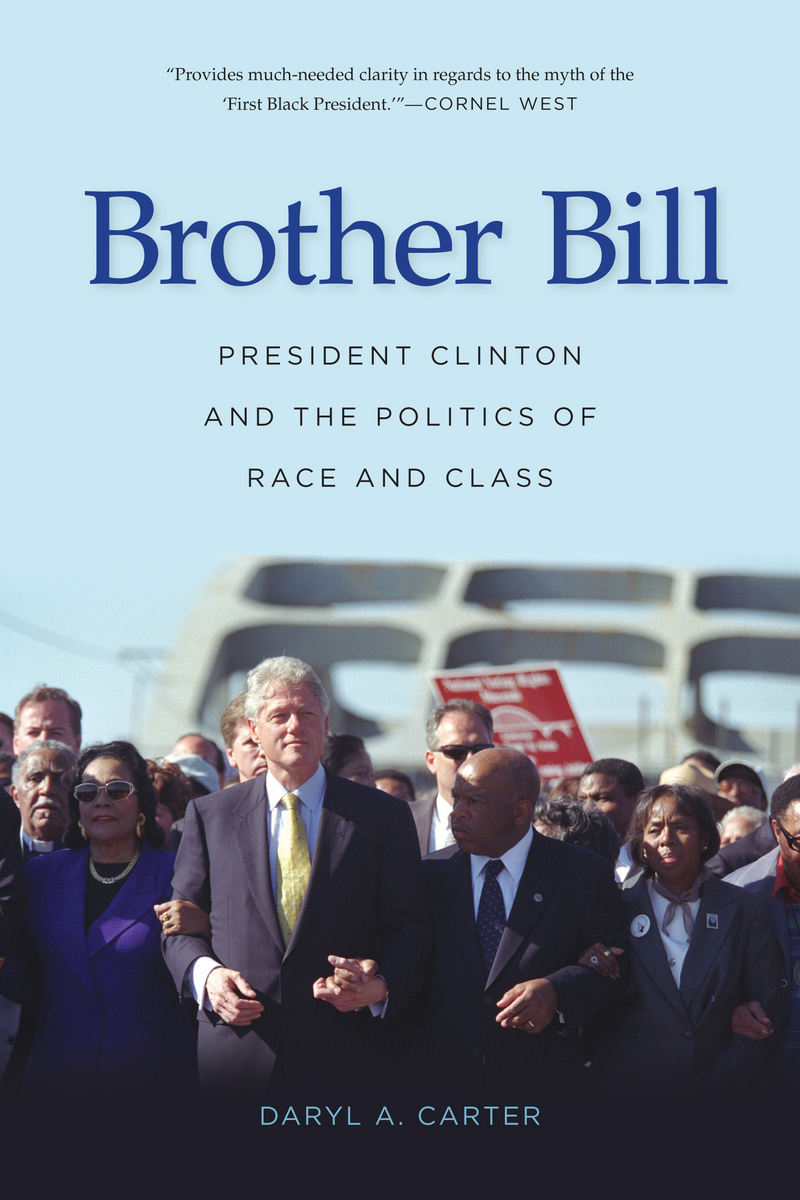
Brother Bill: President Clinton and the Politics of Race and Class
University of Arkansas Press, 2016
Cloth: 978-i-68226-002-9 | Paper: 978-i-55728-699-4 | eISBN: 978-ane-61075-585-6
Library of Congress Classification E886.2.C37 2016
Dewey Decimal Classification 973.929092
ABOUT THIS Book | Author BIOGRAPHY | REVIEWS | TOC | Request Attainable FILE
ABOUT THIS BOOK
"This book is a fascinating assay of race and class in the historic period of President Bill Clinton. Information technology provides much-needed clarity in regards to the myth of the 'Showtime Blackness President.' Information technology contributes much to our agreement of the history that informs our present moment!"
—Cornel West
As President Barack Obama was sworn into office on January xx, 2009, the U.s. was abuzz with talk of the showtime African American president. At this historic moment, i man standing on the countdown platform, seemingly a relic of the past, had actually been chosen by the moniker the "get-go black president" for years.
President William Jefferson Clinton had long enjoyed the support of African Americans during his political career, only the man from Hope besides had a complex and tenuous relationship with this faction of his political base of operations. Clinton stood at the nexus of intense political battles between conservatives' demands for a render to the by and African Americans' demands for change and fuller equality. He also struggled with the course dynamics dividing the American electorate, particularly African Americans. Those with financial means seized newfound opportunities to go to higher, enter the professions, pursue entrepreneurial ambitions, and engage in mainstream politics, while those without financial means were substantially left backside. The quondam became key to Clinton'due south political success equally he skillfully negotiated the African American grade structure while at the same time maintaining the support of white Americans. The results were tremendously positive for some African Americans. For others, the Clinton presidency was devastating.
Blood brother Bill examines President Clinton's political relationship with African Americans and illuminates the nuances of race and class at the finish of the twentieth century, an era of technological, political, and social upheaval.
Author BIOGRAPHY
Daryl A. Carter is associate professor of history at Eastward Tennessee Land University. He specializes in modern American political history and African American history.
REVIEWS
"This book is a fascinating analysis of race and class in the age of President Pecker Clinton. Information technology provides much-needed clarity in regards to the myth of the 'First Black President.' Information technology contributes much to our agreement of the history that informs our nowadays moment!"
—Cornel West
"Race had everything to do with the steady ascension of the Republican Party after the 1964 election, and during Clinton'southward remaking of the Democratic Party he often tweaked the party's positions in a direction meant to bring white voters back into the fold. Daryl Carter's Blood brother Beak is a long, patient recitation of these efforts. … Carter writes in a deliberately measured, even sweet-natured vocalism that puts his account at a far remove tonally from, say, Michelle Alexander's The New Jim Crow or Ava DuVernay'southward documentary picture 13th. He gives Clinton credit for saving affirmative activeness at a time when it was under severe assault, as it isn't now. He reminds united states of america that the crime and welfare bills Clinton signed had strong black back up in polls at the time and that many black members of Congress voted for both; today, black voters, particularly younger ones, are far more disquisitional of these measures."
—Nicholas Lemann, The New York Review of Books, June 2017
"In Brother Bill, historian Daryl A. Carter digs deep into the hot-push button racial issues of the 1990s to interrogate pop conceptions of Bill Clinton as the first "blackness" president. Not surprisingly, Carter unearths a complicated relationship betwixt African Americans and the Clinton agenda. Class, rather than race, motivated many of the president'due south deportment. Eager to maintain back up from white moderates, Clinton promoted policies that benefited the center class—including the growing black heart class—while ignoring or even harming the African American underclass. … Carter demonstrates a solid grasp of his subject area matter and has made skilful use of an array of primary and secondary sources ranging from government reports to contemporary news articles to recent historical and sociological writings. A handful of oral histories lend his word a personal flair. His insistence that historians of contempo America must practice a ameliorate job of untangling the circuitous interplay betwixt grade and race is a highlight of Brother Beak."
—David Welky, H-Net FedHist, June 2017
TABLE OF CONTENTS
Contents
Acknowledgments
Introduction. "The First Black President?"
Chapter 1. The Democratic Leadership Council and African Americans
Affiliate ii. Race and Class in the 1990s
Affiliate 3. The Politics of Racial Appointments
Chapter iv. Responsibility and Accountability
Chapter five. "Mend It, Don't End Information technology"
Affiliate half dozen. Welfare Reform
Affiliate 7. A Missed Opportunity
Affiliate 8. The Clinton Legacy
Conclusion
Notes
Bibliography
Alphabetize
REQUEST Accessible FILE
If y'all are a educatee who cannot utilise this book in printed course, BiblioVault may be able to supply you with an electronic file for alternative admission.
Please have the accessibility coordinator at your schoolhouse fill out this form.
It tin can take 2-3 weeks for requests to be filled.
Nearby on shelf for United States / Later twentieth century, 1961-2000 / Clinton's administrations, 1993-2001:
9780226794716
9780822958505
jacobsenthervild1986.blogspot.com
Source: https://www.bibliovault.org/BV.book.epl?ISBN=9781557286994
0 Response to "Brother Bill President Clinton and the Politics of Race and Class Review"
Post a Comment